

The Rise of Caffeine in Endurance Sport: Why Coffee Fruit Beats a Synthetic Hit
I Am GroundedThe quick answer
Caffeine improves endurance performance mainly by lowering how hard an effort feels. But most race fuel uses synthetic caffeine, which gives you the stimulant and nothing else. Coffee fruit delivers caffeine the way nature packaged it — wrapped in polyphenol antioxidants, alongside real food. Every I Am Grounded SUPR Bar carries 20–60mg of natural caffeine, 8g of plant protein and 6–7g of fibre, all powered by upcycled coffee fruit.
Walk any start line today and you will spot it everywhere: caffeinated gels, chews, gums and pre-mixed bottles. Caffeine has become the most-used and most-researched legal performance aid in endurance sport. This is the story of why it took over, the one thing the caffeine boom skips, and how coffee fruit fixes it.
Why do endurance athletes use caffeine?
Caffeine works by blocking adenosine, the molecule that builds up through a long effort and tells your brain you are tired. Block it, and the same pace simply feels easier. Sports scientists have repeatedly shown that caffeine lowers perceived effort and helps athletes hold output deeper into a race, which is why it now appears in almost every fuel brand's range. The commonly studied performance range is roughly 3 to 6 mg per kg of bodyweight, taken around 45 to 60 minutes before you need it.
The catch is that more is not better. Overshoot the dose, take it too late in the day, or try it on a gut that has not practised with it, and caffeine stops helping and starts causing problems. The goal is the right dose at the right moment, not the biggest hit.
What is the problem with synthetic caffeine?
Most gels and pre-workouts use caffeine anhydrous: a synthetic, lab-isolated powder. It is cheap, precise and fast. But it is caffeine stripped of everything else — just the stimulant, with nothing alongside it.
That matters because hard training and racing create oxidative stress, the cellular wear-and-tear that comes with pushing your body. A bare dose of synthetic caffeine does nothing to help you handle it. You get the stimulant and none of the support. This is where antioxidants earn their place: polyphenol antioxidants help your body mop up that oxidative stress, so the smarter goal is caffeine and antioxidants together, not caffeine alone.
What is coffee fruit, and why is it better?
Coffee does not grow as a bean. It grows inside a bright red fruit that tastes of berries and stone fruit. For a century that fruit has been treated as waste while only the bean was kept — roughly 20 billion kilograms of coffee fruit is discarded every year to feed the world's coffee habit. We upcycle it, because the fruit turns out to be the good part.
Coffee fruit delivers caffeine wrapped in polyphenol antioxidants, and it is seriously antioxidant-rich. Independent analysis of the coffee fruit concentrate we use, grown in Colombia, found it carries 80–90% more antioxidant capacity than blueberries, pomegranates and grapes, and around five times the polyphenols of green tea and grapes, led by chlorogenic acids.1 That sits within a broader body of science: whole coffee fruit is recognised as especially rich in chlorogenic acid polyphenols,2 and it has been tested in humans, not just the lab — in one clinical trial, a single serving of whole coffee fruit concentrate raised blood levels of BDNF (brain-derived neurotrophic factor), a protein that helps keep brain and nerve cells healthy, in healthy adults.3
Upcycling coffee fruit tackles a real waste problem too, turning a discarded crop into functional nutrition. Caffeine for the work, antioxidants for the recovery, and less food waste in the process.
How much caffeine and antioxidants are in I Am Grounded?
Because our caffeine comes from real food, you can plan it like food. Here is exactly what is in each product, across our SUPR Bars and Superfruit Clusters.
SUPR Bars (per 45g bar)
| Bar | Caffeine | Vs a coffee | Protein | Fibre |
|---|---|---|---|---|
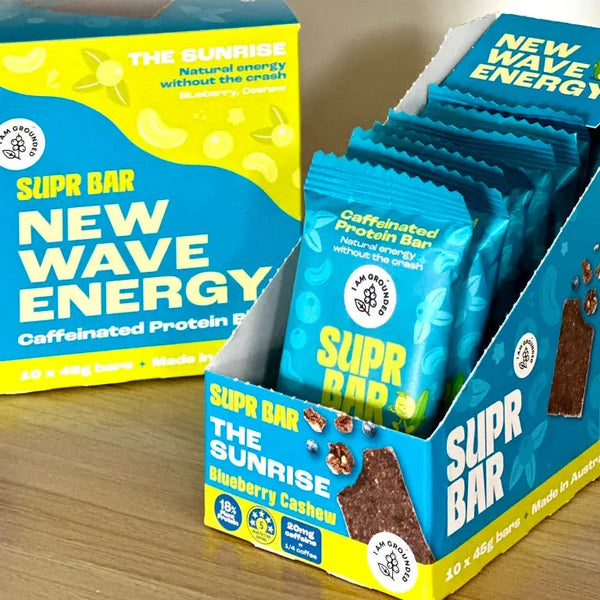
| The Sunrise · Blueberry & Cashew | 20mg | ¼ cup | 8.1g | 6.1g |
| The 3pm · Cocoa & Almond Choc | 40mg | ½ cup | 8.0g | 7.0g |
| The Pick-me-up · Espresso & Peanut Butter | 60mg | 1 cup | 8.4g | 7.0g |
Every bar is 18–19% plant protein and a source of prebiotic fibre (from chicory root inulin), around 190–202 calories, with no synthetic caffeine anywhere in sight.
Superfruit Clusters (per bag)
The clusters carry 71mg of natural caffeine per bag (about one cup of coffee, or roughly 21mg per 30g serve) and a measured antioxidant capacity worth calling out:
- Banana, Coconut & Coffee Fruit (The Brain Booster): 11,336 µmol TE antioxidant capacity per bag, plant-based, crunchy and light.
- Choc Crunch & Coffee Fruit (Recovery + Focus): 15,521 µmol TE per bag, plus 20g of protein and 7g of fibre per bag for active recovery.
The clusters are just as good spooned over yoghurt as they are straight from the bag. For a few ideas, see our Superfruit Cluster breakfast bowls.
Antioxidant capacity is measured by the ORAC method (oxygen radical absorbance capacity), a laboratory test of how well a food neutralises free radicals. It is an in-vitro measure, so treat it as a useful comparison between foods rather than a guaranteed effect in the body.
Coffee fruit bar vs a caffeine gel: how do they compare?
Here is a I Am Grounded SUPR Bar next to a typical caffeinated energy gel, for caffeine delivery.
| I Am Grounded SUPR Bar | Typical caffeine gel | |
|---|---|---|
| Caffeine source | Natural, from coffee fruit | Synthetic caffeine anhydrous |
| Caffeine | 20, 40 or 60mg (you choose) | ~50–100mg (fixed) |
| Antioxidants | Polyphenols from coffee fruit | None |
| Protein | ~8g plant protein | 0g |
| Fibre | 6–7g prebiotic fibre | 0g |
| Made from | Whole nuts, dates and fruit | Sugar syrups (maltodextrin/fructose) |
To be fair to gels: they are built to dump fast-absorbing carbohydrate into your bloodstream mid-race, and a bar cannot match a gel for that specific job. But for your daily caffeine, your pre-session lift and your post-training refuel, a coffee-fruit bar gives you the caffeine plus protein, fibre, antioxidants and real food that a gel simply does not carry.
How should you dose caffeine around training and racing?
Match the dose to the moment rather than guessing. Our three strengths map to three jobs:
- 20mg (The Sunrise): a gentle lift for pre-race nerves, an easy morning, or an afternoon that just needs a nudge.
- 40mg (The 3pm): a steady mid-strength hit for long training blocks and the classic afternoon slump.
- 60mg (The Pick-me-up): the espresso-strength option for race morning and big sessions.
Two rules make caffeine work for you rather than against you. First, practise it — never try a new caffeine dose for the first time on race day; train your gut with it the way you train your legs. Second, mind the clock — caffeine has a long tail, so save the 60mg option for mornings and reach for the gentler 20mg when it is getting late.
Frequently asked questions
Is coffee fruit caffeine better than synthetic caffeine?
They deliver the same active molecule, so the stimulant effect is comparable dose for dose. The difference is what comes with it: coffee fruit brings polyphenol antioxidants and real food, while synthetic caffeine anhydrous is the isolated stimulant on its own.
How much caffeine is in an I Am Grounded bar?
SUPR Bars come in three strengths: 20mg (The Sunrise), 40mg (The 3pm) and 60mg (The Pick-me-up) per 45g bar, equal to roughly a quarter, half and one cup of coffee. The Superfruit Clusters carry 71mg per bag.
Is coffee fruit high in antioxidants?
Yes. Independent analysis of the coffee fruit concentrate we use found around 80–90% more antioxidant capacity than blueberries, pomegranates and grapes, and about five times the polyphenols of green tea and grapes. On pack, our Superfruit Clusters carry a measured 11,336 (Banana) and 15,521 (Choc Crunch) µmol TE of antioxidant capacity per bag.
When should I take caffeine before a race?
Research generally points to around 45 to 60 minutes before you need the effect, at roughly 3 to 6 mg per kg of bodyweight. Always rehearse your dose and timing in training first.
Is coffee fruit sustainable?
Yes. Around 20 billion kilograms of coffee fruit is discarded globally each year. We upcycle it, turning a waste stream into functional nutrition.
Fuel your next session
Real caffeine, from real fruit, with the antioxidants nature packed alongside it. Pick your dose.


Can't decide?
Try all three strengths
The 9 Bar Mixed Box brings together three of each — 20mg, 40mg and 60mg — so you can find your dose for every moment. Just $36.
Shop the Mixed Box
Sources.
1. Independent analysis of the coffee fruit concentrate used in I Am Grounded products (Brunswick Laboratories ORAC testing and supplier polyphenol analysis).
2. Mullen W, et al. "The Antioxidant and Chlorogenic Acid Profiles of Whole Coffee Fruits Are Influenced by the Extraction Procedures." Journal of Agricultural and Food Chemistry, 2011.
3. Reyes-Izquierdo T, et al. "Modulatory effect of coffee fruit extract on plasma levels of brain-derived neurotrophic factor in healthy subjects." British Journal of Nutrition, 2013;110(3):420–425.
Product figures are from I Am Grounded product specifications, supplier certificates of analysis, and packaging. This article is general information about caffeine and active nutrition, not medical or dietary advice. Caffeine affects everyone differently; if you are pregnant, sensitive to caffeine, or managing a health condition, check with a health professional about what is right for you.